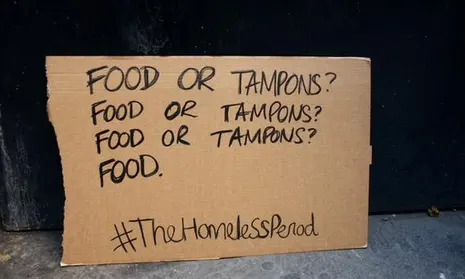
The Centre for Homelessness Research and Practice team have been working on a qualitative review of literature on people’s experiences of menstruating whilst homeless. This review accumulated existing research, both qualitative and quantitative, and generated themes around the difficulties faced by those who have their menstrual cycles while rough sleeping and in supported accommodation.
The World Health Organisation has called for menstrual health to be recognised as a health and human rights issue, not a hygiene issue. They argue for the provision of education and access to menstrual health products for women, girls and everybody who menstruates (WHO, 2022). Despite this, period poverty prevails around the world and menstrual health is not recognised or addressed as a human rights issue. This particularly extends to marginalised groups such as those experiencing homelessness who are one of the most under-served.
“The homeless period – a qualitative evidence synthesis” aims to highlight this issue and generate an evidence base for better access, policy change and action around menstrual health for those experiencing homelessness. From the existing research, our themes were constructed as follows;
- Challenges of managing menstruation whilst homeless
- Lack of/limited facilities and privacy
- Limited access to hygiene products
- Menstruation is expensive
- Difficulties in maintaining hygiene while menstruating
- Feelings of embarrassment, shame and dignity linked to maintaining menstrual hygiene
- Making do: how people living with homelessness manage challenges related to menstruation
- Being creative with alternative solutions
- Last resorts: Sacrifices to access the resources needed to manage menstruation
- What services do women living with homelessness find useful?
The overarching finding is that we need to do better. Those menstruating whilst homeless have limited access to hygiene products and hygienic places to change them, and as a result experience a poor quality of menstrual health. They may be forced to forgo other necessities to afford hygiene products, receive inappropriate or low quality products though donation schemes and experience increased stigmatisation as a result of their menstruating status. People who do not identify as female and menstruate, such as non-binary and transmasculine people, are neglected in the literature and there is a need to better understand their unique experiences.
Our aim is to take this research further, understand people’s experiences and ask them what they need from services, commissioners and policy design in order to feel better able to manage their menses. We are aiming for a more inclusive sample of participants, including aforementioned gender-diverse groups, and hope to use a creative qualitative approach to capture people’s experiences in a way which raises awareness to the wider public about this issue.
We are excited to have an advisory board with experts in related fields including;
Jenna Mason Homelessness Peer mentor with Outcome Home, Dr. Polly Hardy-Johnson of University of Southampton Primary Care Population Sciences and Medical Education (PPM), Carly Norman leading Two Saints Southampton Kaleidoscope Project, Dr. Laura Brown of University of New Mexico Center for Alcohol, Substance Use, and Addictions (UNM CASAA) and Rachael Roberts from Social Enterprise Diversity and Ability.
WHO, 2022 [retrieved from https://www.who.int/news/item/22-06-2022-who-statement-on-menstrual-health-and-rights 07/11/2023)