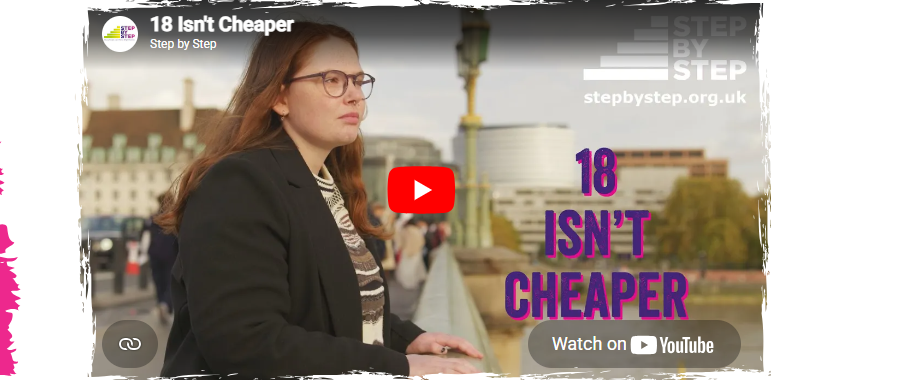
Our short film, 18 Isn’t Cheaper, draws on lived experience, research evidence and policy insight to examine how the current Universal Credit system places care leavers aged 18 to 24 at a disadvantage. The film features the voices of young people, Supported Lodgings hosts and professionals supporting their move towards independence.
At the CHRP, our work focuses on understanding the realities of people’s lives when experiencing homelessness, or the risk and protective factors concerning homelessness. We aim to ensure that research leads to meaningful change.
In 2024, we partnered with Step by Step Partnership to co-produce Moving Towards Independence, a study exploring what happens when young people leave care or Supported Lodgings and begin life on their own.
What we found was both clear and concerning.
For many young people, turning eighteen is not a smooth transition into adulthood. It is a cliff edge in expectations, responsibility and financial pressure. And critically, it is a point at which the system begins to provide less support, not more.
A transition that doesn’t reflect reality
Young people leaving care are expected to manage the same core costs as any adult: rent, utilities, food, transport and daily essentials.
Yet those under 25 receive a lower rate of Universal Credit.
From a policy perspective, this distinction is based on age.
From a lived experience perspective, it does not make sense.
Costs do not reduce at eighteen.
Responsibilities do not reduce at eighteen.
If anything, both increase.
Our research highlights a fundamental mismatch between what is expected of young people and what they are given to work with.
A study grounded in lived experience
Moving Towards Independence was designed as a co-produced project, meaning young people were not simply participants but contributors to shaping the research itself.
This approach matters.
It shifts the focus from observing experiences to understanding them from the inside, capturing not just what happens, but how it feels, what it means, and what needs to change.
Across the study, young people consistently described the move to independence as a period of:
- financial strain
- uncertainty around housing
- fragmented support
- limited preparation for what comes next
These are not isolated challenges. They are systemic.
Four priorities for change
Through the research, four key recommendations emerged. These reflect both lived experience and wider evidence on what supports successful transitions into adulthood.
1. Fair financial support
Young people were unequivocal: Universal Credit should be paid at the full adult rate for care leavers under 25.
This is not about additional support. It is about alignment with reality.
Living costs are consistent across age groups. Financial support should be too.
2. Improved access to housing
Accessing safe and stable housing was one of the most significant challenges identified.
Young people highlighted the need for:
- clearer guidance on housing processes
- greater transparency in how decisions are made
- higher priority within housing systems
Without this, the risk of instability increases at precisely the moment stability is most needed.
3. Consistent, ongoing support
Transitions into independence are not purely practical. They are relational and emotional.
Young people emphasised the importance of continuity in support, rather than being required to repeatedly explain their circumstances to new professionals.
Consistency builds trust. Trust enables progress.
4. Earlier and clearer preparation
Many participants described feeling underprepared for the move into independence.
They called for clear information at least six months in advance, covering expectations, processes and entitlements.
Preparation is not a luxury. It is a protective factor.
Understanding the reality behind the data
Alongside the research findings, individual experiences help illustrate what these challenges look like in practice.
One young person described being asked for six months’ rent upfront when trying to secure accommodation. For someone in education, this was simply not feasible.
Everyday decisions, such as travelling to see friends, became financial calculations with trade-offs. Longer months placed additional strain on already stretched budgets.
Importantly, these experiences were not the result of poor financial management. They reflected the cost of meeting basic needs with insufficient income.
When stable support was available, outcomes shifted significantly. With the security of Supported Lodgings and consistent encouragement, this same young person progressed into higher education and began planning a professional future.
The capability was always there. The difference was the level of support.
A structural issue, not an individual one
A key insight from this work is that these challenges are not about individual resilience or effort.
Young people leaving care often demonstrate considerable determination and adaptability. However, resilience should not be relied upon to compensate for structural gaps.
When financial support does not meet basic living costs, the consequences can include:
- increased risk of housing instability
- financial insecurity and debt
- poorer mental health outcomes
- disrupted education or employment pathways
These are predictable outcomes of systemic conditions, not personal shortcomings.
The case for policy change
Based on our findings, we support the call for Universal Credit parity for care leavers aged 18 to 24.
Providing the full adult rate would:
- better reflect the actual cost of independent living
- reduce the need for crisis budgeting
- support more stable housing outcomes
- enable young people to focus on education, training and employment
This is a targeted and practical policy change with the potential for significant impact.
Why this matters now
A Private Member’s Bill proposing Universal Credit parity for care leavers has progressed through the House of Lords and is now awaiting scheduling in the House of Commons.
This presents an important opportunity.
Research, when combined with lived experience and practitioner insight, can inform policy in ways that are both evidence-based and grounded in reality. This is one such moment.
Eighteen isn’t cheaper
One of the most powerful messages to emerge from this work is also the simplest.
Turning eighteen does not make life less expensive.
Policies that assume otherwise risk placing young people at a disadvantage at a critical point in their lives.
If we are serious about supporting successful transitions into adulthood, preventing homelessness and enabling young people to thrive, then financial support must reflect the realities they face.
At the University of Southampton, we believe that research should do more than describe problems. It should contribute to solutions.
This is one of them.
Eighteen isn’t cheaper.
It’s time our systems recognised that.